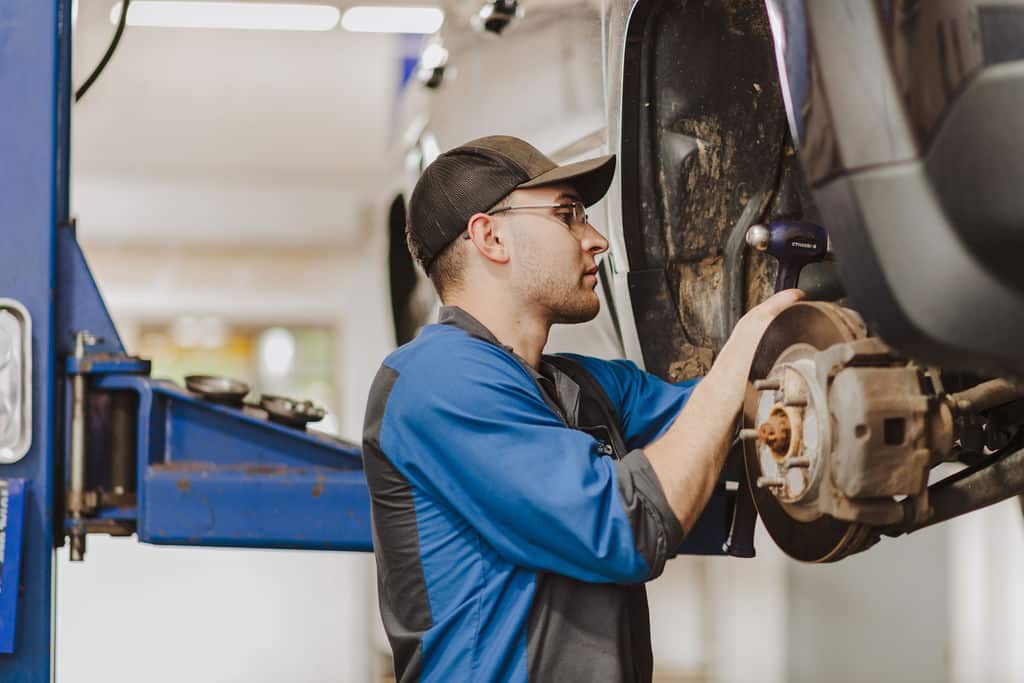
Your emergency brake, also called a parking brake, handbrake, or e-brake, is one of your vehicle’s most important safety features. It keeps your vehicle from rolling when parked and provides a backup braking system if your primary brakes fail.
Like every part of your vehicle, the parking brake wears out over time. Cables stretch, components rust, and parts eventually need adjustment or replacement. If you ignore the warning signs, you could face expensive repairs, or worse, an unsafe vehicle.
How do you know if your emergency brake needs attention? Here are seven common signs to watch for.
How Does an Emergency Brake Work?
Your emergency brake, or parking brake, works separately from your vehicle’s primary hydraulic braking system. Its main job is to keep your vehicle securely in place when parked.
Traditional parking brakes typically use a lever or pedal connected to the rear brakes by cables. Many newer vehicles use an electronic parking brake that engages with the push of a button.
Over time, cables can stretch or corrode, brake components can wear down, and electronic components can malfunction. Regular brake inspections can help identify problems before your parking brake stops working properly.
1. Your Vehicle Rolls After You Set the Parking Brake
Your vehicle should stay in place after you engage the parking brake. That applies whether you’re parked on a hill or a flat surface.
If your vehicle rolls, even slightly, your parking brake isn’t providing enough holding force.
Several problems can cause this, including:
- Stretched brake cables
- Worn parking brake shoes or pads
- Damaged brake hardware
- Components that need adjustment
Don’t ignore this issue. A vehicle that rolls unexpectedly creates a serious safety risk.
2. The Brake Lever or Pedal Feels Loose
Your parking brake should engage with firm, steady resistance.
If the lever feels loose or the pedal travels farther than normal, something isn’t right. A stretched cable or worn component often causes this problem.
The longer you wait, the less effective your parking brake may become.
3. Your Emergency Brake Won’t Fully Engage
Does your parking brake refuse to lock into place? Does it release unexpectedly?
These symptoms often point to worn or damaged internal components. In some cases, the system simply needs an adjustment. In others, it may require replacement parts.
Either way, your vehicle may not stay parked safely until the problem is repaired.
4. You Hear Grinding, Squeaking, or Rattling
Your vehicle shouldn’t make unusual noises when you apply or release the parking brake.
Listen for sounds like:
- Grinding
- Squealing
- Scraping
- Rattling
Worn brake shoes, rusted hardware, damaged cables, or dirty components often cause these noises.
A professional inspection can identify the source before the problem gets worse.
5. The Parking Brake or Brake Warning Light Stays On
If your parking brake or brake warning light stays illuminated after you release the parking brake, don’t ignore it.
Depending on your vehicle, a warning light could indicate:
- The parking brake isn’t fully released
- Low brake fluid
- A faulty sensor or switch
- An electronic parking brake malfunction
- Another brake system problem
Because brake warning lights can indicate more than one issue, it’s important to have the system inspected rather than assuming the parking brake itself is the only problem.
6. The Parking Brake Won’t Release
Your parking brake should release smoothly every time.
If the lever sticks, the pedal won’t return, or the electronic parking brake won’t disengage, you may have rusted cables or damaged mechanical parts.
Driving with the parking brake partially engaged creates extra heat and unnecessary wear. It can also damage your brake system and reduce fuel efficiency.
7. You Notice a Burning Smell While Driving
A parking brake that doesn’t fully release can keep brake components engaged while you’re driving, creating excessive friction and heat.
You may notice a strong burning smell, reduced performance, or unusual heat coming from around one of the wheels.
Continuing to drive with a dragging parking brake can damage:
- Brake pads
- Rotors
- Calipers
- Wheel bearings
- Other nearby components
If you smell burning brakes or notice excessive heat near a wheel, have your vehicle inspected as soon as possible.
What Causes Emergency Brake Problems?
Parking brakes usually don’t fail without warning. Most problems develop gradually over time.
Common causes include:
- Normal wear and tear
- Rust and corrosion
- Stretched brake cables
- Worn brake pads or shoes
- Driving with the parking brake partially engaged
- Skipping routine brake maintenance
Regular brake inspections help catch these problems early. They can also prevent more expensive repairs later.
Can You Drive with a Faulty Emergency Brake?
It depends on the problem. If your parking brake simply won’t hold the vehicle when parked, your regular brakes may still function normally—but you should have the parking brake repaired as soon as possible.
If the parking brake won’t release, is dragging, produces a burning smell, or affects how the vehicle drives, don’t continue driving. Doing so can generate excessive heat and damage other brake components.
Because your parking brake is an important part of your vehicle’s braking system, any suspected problem should be professionally inspected.
Emergency Brake Repair in Fort Collins
If your parking brake won’t hold, won’t release, feels loose, or is showing other signs of trouble, McCormick Automotive can diagnose the problem and recommend the appropriate repair.
Our technicians can:
- Inspect your parking brake system
- Adjust stretched brake cables
- Replace worn components
- Inspect your complete braking system
- Recommend the repairs your vehicle actually needs
We believe in honest recommendations and transparent pricing. We’ll explain our findings clearly and answer your questions before any work begins.
Schedule Your Brake Inspection Today
Your parking brake is easy to overlook until it stops working.
If you’ve noticed any of these warning signs, don’t wait. A professional inspection can identify the problem before it turns into a more expensive repair.
At McCormick Automotive, we’re committed to keeping Fort Collins drivers safe on the road. Whether your parking brake needs an adjustment or a more extensive repair, our experienced technicians are here to help.
Schedule your brake inspection today and drive with confidence knowing your vehicle’s braking system is working properly.